Working Paper v19 · July 2026
The Framework.
Transmutarianism evaluates moral work as transmutation: the relationship between what an agent absorbs (receives) and what it emits (provides to others) across hierarchically-weighted human need dimensions.
Abstract
This paper introduces Transmutarianism, a novel ethical framework that evaluates moral work from transmutation: the relationship between what an agent absorbs (receives) and what it emits (provides to others) across hierarchically-weighted human need dimensions. Unlike consequentialist frameworks that treat agents symmetrically, Transmutarianism accounts for differential starting conditions. The framework's foundation is a declared taxonomy of human need dimensions; Maslow's hierarchy is its default implementation, and comparative human-needs frameworks (Max-Neef, Doyal and Gough) substitute without changing the functional. This provides both theoretical structure and empirical measurability.
Transmutarianism operates as moral accounting with declared normative parameters: it measures flows of relational value using economic mechanisms, declares the weights and standards that make each placement normative, and leaves questions of moral worth to cultures, religions, and individual communities. The framework is designed to replace the practice of moral exhortation of individual agents with distributed measurement of network effects. The Conduit, the agent at the origin who passes through exactly what they receive, establishes the morally neutral baseline from which all transmutation is measured. Because deterministic passthrough is the default, the framework emphasizes systemic intervention over individual moral exhortation: designing environments where neutral processing produces net positive flows.
The asymmetry coefficient τ serves as a cultural control mechanism, allowing different communities to calibrate the relative weight of filtering versus amplification according to their values, and the power-asymmetry coefficient ρ holds more powerful agents to a higher standard by shifting their neutral origin up the moral axis, so that pure passthrough scores negative from power. v19 states the accounting as normative scoring with declared parameters and frames the ledger terms (Moral Debt, extraction) accordingly, demotes Maslow's hierarchy to the default filling of a declared need-taxonomy slot, restructures the empirical sections for falsifiability with an adverse-evidence assessment and a claims-by-type table, adds a causal-attribution model to the field scoring protocol, and works a source-linked institutional case in full. It retains the field operationalization introduced in v18: the evaluation denominator and window, the aggregate position, the power-handicap composition with its band protocol, the booking rules for counterfactuals and diverted resources, the agent taxonomy for statutes and programs, the Field Scoring Protocol, and cognitive sovereignty. Version history and the provenance of retained constructs are recorded in Appendix C of the paper.
We present formal mathematical definitions, analyze edge cases, propose measurement instruments and a reproducible field protocol, identify unique theoretical separators from existing ethical frameworks, assess empirical support for the framework's core claims, and establish the framework's applicability to all autonomous systems, including artificial intelligence agents.
Key Constructs
| Term | Symbol | Definition |
|---|---|---|
| Fulfillment | D+ | The state of having a need met at a given Maslow level. |
| Deprivation | D− | The state of having a need unmet at a given Maslow level. |
| Filtering | F = D−(in) − D−(out) | Reduction of deprivation through an agent. Positive values indicate the agent absorbed more deprivation than they emitted. |
| Amplification | A = D+(out) − D+(in) | Generation of fulfillment through an agent. Positive values indicate the agent emitted more fulfillment than they absorbed. |
| Moral Work | M = [τ(F−F₀)+(A−A₀)] / √(τ²+1) | Net transmutation at need level n, a unit-scale isometric projection in which τ rotates the iso-moral lines without rescaling. |
| Power-Asymmetry | ρ ≥ 1 | Raises the standard for a powerful agent by shifting its neutral origin (F₀, A₀) up the moral axis. ρ = 1 is parity. |
| Steepness Anchor | u | Per-period rate converting power surplus into required moral work. Default 1; the handicap ΔM = (ρ−1)u accrues with the evaluation window. |
| Evaluation Denominator | The declared population whose flows enter the four flow variables. Default: the full population the agent's flows act on. | |
| Evaluation Window | T | The declared period over which flows are totaled. Evaluations compare at a common window or as per-period rates. |
| Moral Capital | C+ | Accumulated positive moral standing from sustained transmutation work. |
| Moral Debt | C− | Accumulated obligation from extraction (net absorption exceeding emission). A starting position, not a permanent sentence. |
The central moral question shifts from "What should I do?" to "What am I doing to the flows that pass through me?"Transmutarianism v19, Section 2
The Four Agent Archetypes
+F, +A
Transmuter
Filters deprivation and amplifies fulfillment. The cycle-breaker who absorbs hardship without passing it on, and emits more belonging than they received. Example: an abuse survivor who becomes a nurturing counselor.
+F, −A
Absorber
Filters deprivation. Carries hardship without spreading it, while emission stays at the level received. Common in caregivers running on empty. Example: the stoic who endures hardship quietly without generating joy.
−F, +A
Magnifier
Amplifies both fulfillment and deprivation. High throughput on both flows; emits more of whatever passes through, in either direction. Example: a charismatic leader who inspires and also damages.
−F, −A
Extractor
Amplifies deprivation while absorbing fulfillment without proportional emission. Generates moral debt: takes more than is given, emits more harm than was received. Example: a privileged abuser who spreads harm.
F = 0, A = 0
The Conduit (Baseline)
Morally neutral. Passes through exactly what is received. Most agents, most of the time, function as Conduits. This is the framework's deterministic baseline, the default from which all transmutation is measured. Transmutation is deviation from baseline that requires explanation.
The four archetypes and the Conduit plotted in transmutation space, alongside worked examples. The dashed lines are iso-moral contours. Drag τ to rotate them, and ρ to raise the neutral M = 0 bar.
Mathematical Formalization
For any moral agent A over time period T, define the following variables for each Maslow need level n in {physiological, safety, belonging, esteem, actualization}: D+(in), D−(in), D+(out), D−(out). Each variable is measured in comparable units within each need level.
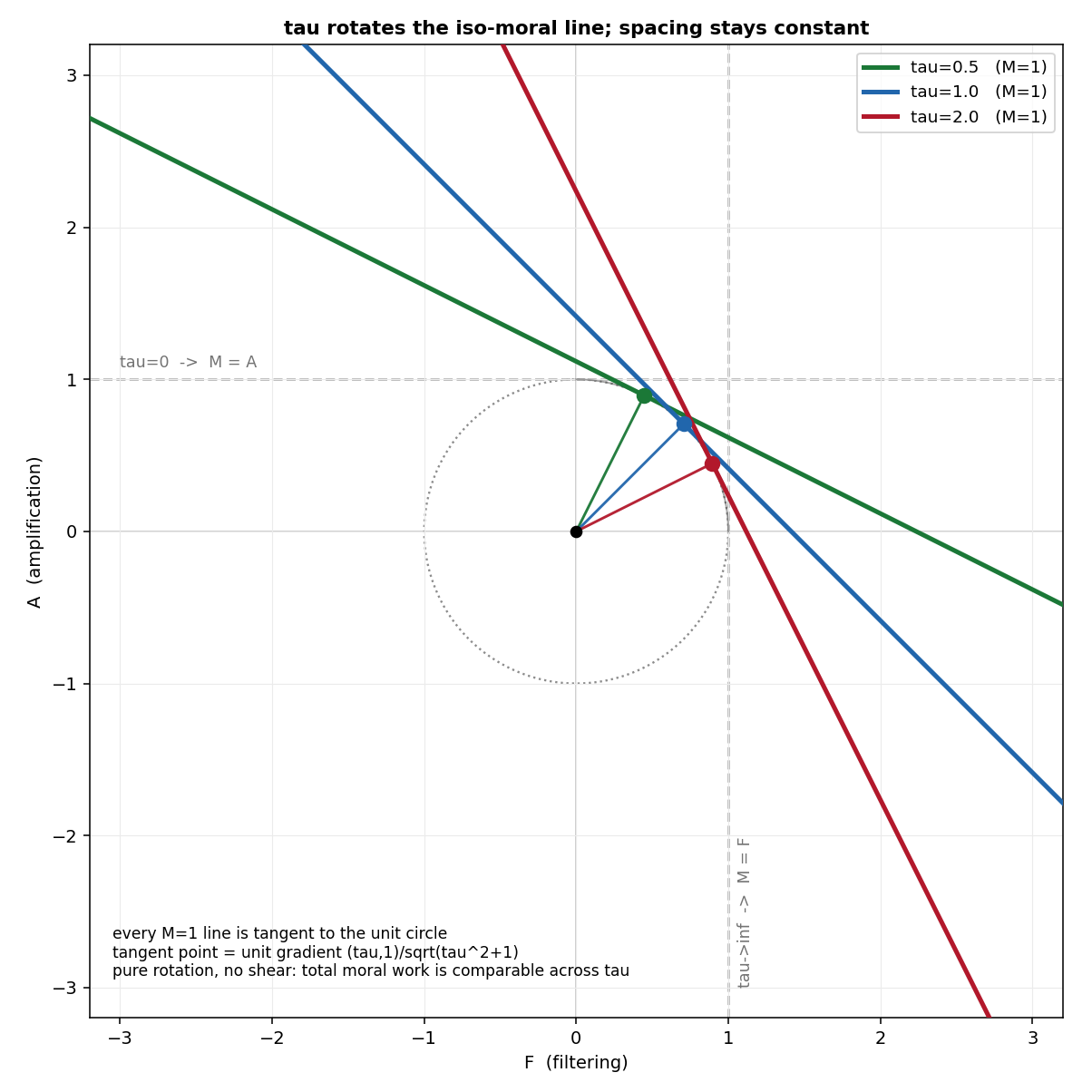
τ rotates, it does not rescale. The 1/√(τ² + 1) normalizer fixes the gradient magnitude at 1, so τ acts as a pure rotation of the iso-moral lines (constant spacing) rather than a shear plus rescale. Total moral work is therefore comparable across τ. The projection has clean endpoints: τ = 0 gives A, τ → ∞ gives F, and τ = 1 gives (F + A)/√2. The proportional shorthand M = τF + A still describes the direction of the filtering-versus-amplification trade-off.
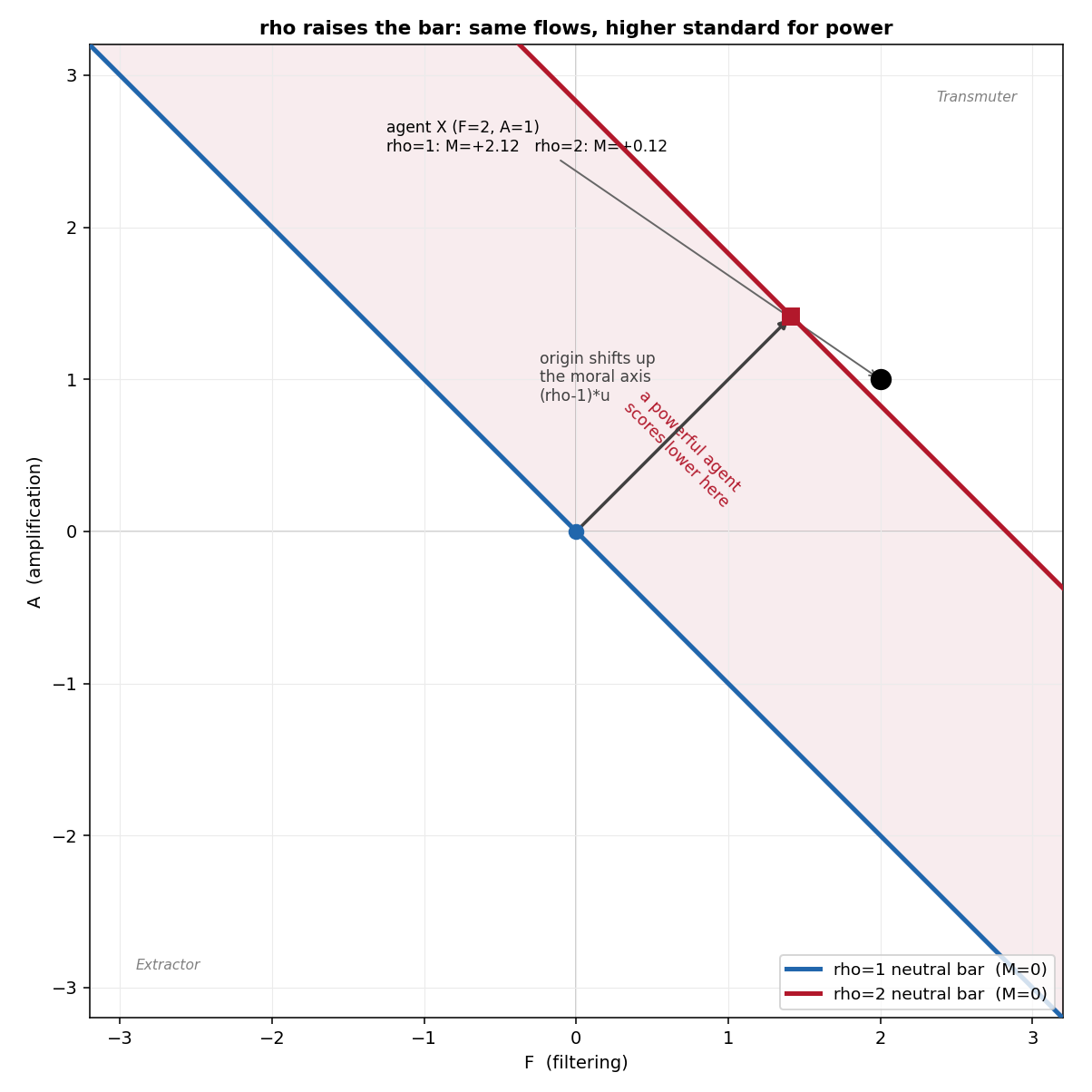
ρ raises the bar for the powerful. The neutral origin sits at (0, 0) for an agent at parity (ρ = 1). For a more powerful agent it shifts up the moral axis by (ρ − 1)·u, so the same flows clear a higher M = 0 bar. This formalizes the higher-standard-for-the-powerful intuition and is guarded to voluntary power by the Chosen Sacrifice Principle. The shift is a separate ledger from Moral Capital, so there is no double-count.
Default parameters. τ = 1 (equal weighting of filtering and amplification), ρ = 1 (parity, neutral origin at 0), origin (F₀, A₀) = (0, 0). Hierarchical weights w = {5, 4, 3, 2, 1} for physiological, safety, belonging, esteem, and actualization. All are culturally calibratable. τ greater than 1 emphasizes cycle-breaking; τ less than 1 prioritizes fulfillment generation. The weight vector reflects the position that transmutation at lower Maslow levels carries greater moral weight than transmutation at the actualization level, all else equal.
Reading the Scores
Per-level F and A are scored on a −10 to +10 scale and combined into an aggregate position rescaled to the −100 to +100 axis used by the quadrant. F and A are read independently: an agent can sit high on one axis and low on the other. The bands below are a preliminary interpretive aid for one axis at a time; treat them as orientation rather than a precise instrument.
| Score range | Interpretation |
|---|---|
| +75 to +100 | Exceptional filtering (F) or amplification (A). |
| +25 to +74 | Positive contribution. |
| −24 to +24 | Neutral or mixed, near the Conduit baseline. |
| −25 to −74 | Harmful tendency. |
| −75 to −100 | Strongly extractive. |
An agent's archetype follows from the pair. High positive F with high positive A is a Transmuter; strongly negative on both is an Extractor; near zero on both is a Conduit.
Worked Examples
Three short cases show how the same two axes read across very different agents. The scores are illustrative.
| Agent | F | A | Archetype | Reading |
|---|---|---|---|---|
| Community food bank | + high | + high | Transmuter | Absorbs hunger by filtering deprivation at the physiological level, and distributes food and belonging by emitting fulfillment. Positive on both axes. |
| Predatory payday lender | − low | − low | Extractor | Transfers wealth out of households and raises financial insecurity, passing deprivation on while retaining fulfillment. Negative on both axes. |
| Search engine | mixed | mixed | Depends on implementation | One that reduces barriers to knowledge and surfaces what people need tends positive; one that concentrates attention and sells dependency tends negative. The score follows the implementation rather than the category. |
Agent Taxonomy
Transmutarianism evaluates entities capable of autonomous action. The threshold for evaluation is autonomous decision-making, not sentience, consciousness, or inner experience.
| Category | Criterion | Evaluation Method | Example |
|---|---|---|---|
| Environment | No autonomy, no creator. | Not directly evaluated. Serves as background input to the system. | The sun, weather systems, tectonic activity, gravity. |
| Instrument | No autonomy, created by an agent. | Evaluated in aggregate through the creating or deploying entity. | A light bulb, a tool, a building, a medication. |
| Agent | Capable of autonomous action. Makes allocation decisions that affect resource flows. | Evaluated directly via M = τF + A. Each autonomous decision is a node in the accountability network. | A human, a corporation, an autonomous AI system, a drone with decision-making capacity. |
This taxonomy resolves a common objection: that non-sentient systems cannot be morally evaluated. The framework does not require sentience. It requires measurable resource flows and autonomous decision-making. This is consistent with how legal and economic systems already operate. Incorporation provides the precedent: corporations are non-sentient entities granted a form of agency, evaluated on their resource consumption and impact, regulated, taxed, and held accountable as units separate from their individual shareholders. Transmutarianism extends this established logic to all autonomous systems.
Chain of Responsibility
Traditional moral frameworks collapse responsibility into a single agent: who is to blame? Transmutarianism rejects this compression. In any causal chain involving multiple agents, the framework evaluates M = τF + A at each node independently. Responsibility is distributed across the network, not assigned to a single party.
Consider a drone weapon system. The manufacturer consumed resources and made design decisions, one node. The deploying authority made an allocation decision to deploy, another node. The drone, if capable of autonomous targeting decisions, made operational choices, another node. Each node has its own measurable resource consumption, fulfillment emission, and deprivation emission. The framework maps the full chain. It does not collapse the chain into a single guilty party; it measures every node.
This approach has direct precedent in how economic and legal systems already function. Corporations distribute responsibility through organizational structures, supply chains, and regulatory relationships. A corporation's environmental damage is evaluated at the corporate level even though individual employees made specific decisions. Transmutarianism extends this distributed evaluation logic to any network of heterogeneous agents.
Ten Unique Claims
- Transmutation Primacy. Moral work is primarily determined by transmutation ratio. A high-absorber with low emission scores lower than a low-absorber with equal emission.
- Asymmetry Hypothesis. Filtering deprivation may be weighted differently than amplifying fulfillment. τ = 1 is the null case, empirically testable.
- Extraction Thesis. Absorbing more fulfillment than one emits constitutes moral debt regardless of absolute emission level.
- Hierarchical Weighting. Transmutation at lower Maslow levels carries greater moral weight. Physiological deprivation precedes actualization enablement.
- Systemic Flow Ontology. Morality is fundamentally about flows through agents. Agents are nodes. Moral character is the transmutation function.
- Universal Agent Accounting. The same framework applies to all intelligent agents, human and artificial. The threshold is autonomous action, not sentience.
- The Conduit Baseline. The morally neutral default is the Conduit at (0, 0). Deterministic passthrough is the baseline. Transmutation is deviation that requires explanation.
- Systemic Intervention Primacy. Because agents are morally neutral at baseline, the primary lever is systemic redesign, not individual moral improvement.
- The Chosen Sacrifice Principle. Only voluntary sacrifice generates moral capital. Forced sacrifice generates moral debt in the imposing system. Grounded in UDHR Article 4.
- Regenerative Emission. Fulfillment emission that increases the recipient's own transmutation capacity carries greater moral weight than emission that maintains dependency. Empowerment outranks charity.
Edge Cases
Sixteen problems and resolutions (click to expand)
- The Sink Problem.
- Infinite absorption with zero emission is not optimal. Individual moral accounting and systemic health are distinct; systemic optimality requires some emission to maintain circulation.
- The Origin Problem.
- The framework accommodates fulfillment generation through A > 0 with low D+(in). These agents are "sources." The framework does not require conservation of fulfillment.
- The Counterfactual Problem.
- Substantial evidence (ACE, intergenerational transmission, social network propagation) indicates deprivation does not dissipate on its own. Filtering therefore represents genuine moral work.
- The Indirect Effect Problem.
- Transmutarianism accounts for direct flows. Second-order effects require extended analysis. Recipient selection may be morally relevant when considering whether to emit toward high-transmuters or likely-corruptors.
- The Self-Directed Flow Problem.
- The framework focuses on interpersonal flows. Self-directed fulfillment that enables future emission to others is instrumentally valuable but not directly measured as filtering.
- The Temporal Discounting Problem.
- No discounting, recency weighting, or duration weighting is mandated. Multi-horizon assessment prevents systematic undervaluation of slow-yield work.
- The Intentionality Problem.
- Core Transmutarianism is agnostic to intent. Transmutation ratios matter regardless of motivation. Institutional Moral Capital Deferral allows moral debt to be deferred to institutions with accumulated capital.
- The Recipient Quality Problem.
- Yes, emitting to a high-transmuter counts more. Extended Transmutarianism includes recipient-weighted emission A' = A × E[recipient's transmutation ratio]. This creates incentive to direct flows toward high-transmuters.
- The Extractor Rehabilitation Problem.
- Transmutarianism evaluates moral work, not moral worth. An agent's current transmutation profile does not determine their potential profile. Moral debt is a starting position, not a permanent sentence.
- The In-Group / Out-Group Problem.
- The framework accounts for all interpersonal flows regardless of relationship category. Optional extensions address kinship dynamics through a scope coefficient and systemic completeness tracking.
- The Deprivation Displacement Problem.
- Filtering measures the difference between absorption and emission. An agent who absorbs deprivation and emits equivalent deprivation to another agent has F = 0, representing displacement, not filtering. True filtering requires D−(out) less than D−(in).
- The Differential Starting Conditions Problem.
- Involuntary deprivation absorption at the physiological level generates starting Moral Capital (C+). Deprivation absorbed through no fault or choice creates a moral credit.
- The Regeneration Problem.
- A regeneration coefficient distinguishes providing fulfillment from increasing the recipient's capacity to generate fulfillment independently. Regenerative emission carries a multiplier. This is the line between charity and empowerment.
- The Repair Problem.
- Restoration is itself a form of filtering. An agent who generates deprivation and then performs repair work demonstrates a trajectory from Extractor or Magnifier toward Transmuter. Moral debt from generated deprivation can be partially offset through genuine repair, though the original emission remains on the ledger.
- The Mixed Moral Provenance Problem.
- The framework requires blended moral provenance scoring. Resources carry probabilistic moral weight based on traceable origins, rather than binary classification.
- The Anti-Gaming Problem.
- The framework measures flows from both agent and recipient perspectives. Discrepancies are gaming indicators. Multi-level Maslow accounting, longitudinal tracking, and network-level flow analysis together make fabrication structurally hard.
UDHR Grounding
The framework's structural guardrails are grounded in the United Nations Universal Declaration of Human Rights, providing constitutional-level alignment with established international human rights law.
| UDHR Article | Principle | Transmutarian Connection |
|---|---|---|
| Article 1 | Dignity and rights | Universal agent accounting; differential conditions recognized through starting Moral Capital, not differential worth. |
| Article 4 | No slavery or servitude | The Chosen Sacrifice Principle. Forced extraction generates moral debt in the imposing system, not moral capital in the person enduring it. |
| Article 18 | Freedom of thought, conscience, religion | The asymmetry coefficient enables cultural calibration. Moral worth questions remain with traditions. |
| Article 19 | Freedom of opinion and expression | The framework measures flows without constraining expression. Evaluation is accounting, not censorship. |
| Article 22 | Right to social security | Hierarchical weighting prioritizes physiological and safety needs. Systemic intervention targets foundational need fulfillment. |
| Article 26 | Right to education | Regenerative emission weights education and capacity-building above dependency-maintaining fulfillment. |
| Article 27 | Cultural and scientific participation | Temporal yield dynamics recognize the long-term moral work of cultural and scientific contribution. |
Why Maslow, and Other Traditions
The framework organizes need into Maslow's five levels because they are widely recognized and map cleanly onto measurable deprivation and fulfillment. Maslow's hierarchy emerged from a particular Western intellectual tradition, and it is one account of human need among several. Indigenous relational and land-based conceptions, Buddhist accounts of suffering and its cessation, Confucian relational role ethics, Catholic social teaching on dignity and the common good, and the Ubuntu principle that a person is a person through other people each order human need differently.
The framework does not require Maslow. The level structure and the weight vector w = {5, 4, 3, 2, 1} are calibratable, and the asymmetry coefficient τ already lets a community weight filtering against amplification by its own values. A community that orders need by a different account can substitute its own levels and weights and run the same F and A accounting. Naming these traditions records that the choice of need-structure is open to them.
Extensions
A discourse-measurement extension is the work of the CCII Research Collective (paper in progress). See Discourse as a measurable flow and the standalone tool at /discourse-evaluator/.
Future Research Directions
Transmutarianism is presented as an interpretive instrument rather than a completed science. Its purpose is to provide a structured way of observing the flow of deprivation and fulfillment through individuals, institutions, technologies, and systems. Several areas remain open for refinement and empirical study.
Operationalization of F and A. The framework defines Filtering (F) and Amplification (A) conceptually. Future work will develop standardized indicators, rubrics, and observational measures that support consistent scoring across evaluators and contexts, with particular attention to measurable proxies for deprivation absorbed, deprivation transmitted, fulfillment received, and fulfillment emitted.
Inter-rater reliability. A useful measurement framework lets multiple observers examining the same agent arrive at substantially similar conclusions. Future studies may test the degree to which independent evaluators produce comparable F and A scores on identical cases, establishing the framework's reliability and clarifying where subjective judgment remains.
Weighting and human need. The current weighting assigns greater significance to deprivation at lower Maslow levels than at higher ones, reflecting the position that threats to survival and safety carry greater urgency than threats to esteem or self-actualization. Future research may explore alternative weighting schemes, empirical validation, cultural variation, and whether Maslow's hierarchy remains the most suitable organizing structure.
From metaphor to measurement. The framework employs symbolic language, including the distinction between Babel and Jerusalem, to communicate complex relational dynamics. These metaphors are interpretive guides rather than measurement instruments. Future work will further distinguish symbolic framing from operational criteria so that conceptual clarity and empirical rigor develop together.
Predictive and longitudinal validation. The framework is presently descriptive; it offers a language for the direction of relational flows. Future research may examine whether F and A scores carry predictive value. Longitudinal studies could investigate whether agents with higher positive F and A demonstrate greater resilience, trust, cooperation, and long-term social benefit than agents with persistently negative values.
Agents, instruments, and hybrid systems. The agent taxonomy distinguishes environments, instruments, and autonomous agents, and the framework evaluates an instrument through the entity that creates or deploys it. As AI systems take on more autonomous decision-making, future work will further explore the degree to which technological systems should be treated as agents, instruments, or hybrid socio-technical actors within the framework.
Scope and limits. The framework measures one dimension of social reality: the marginal contribution an agent makes to the flow of deprivation and fulfillment. It does not claim to measure moral truth, spiritual worth, salvation, legal responsibility, or the total condition of a population. The authors regard these open questions as invitations for further inquiry, each marking where the framework can be tested, refined, and strengthened across diverse communities and contexts.
DOI 10.5281/zenodo.21268135